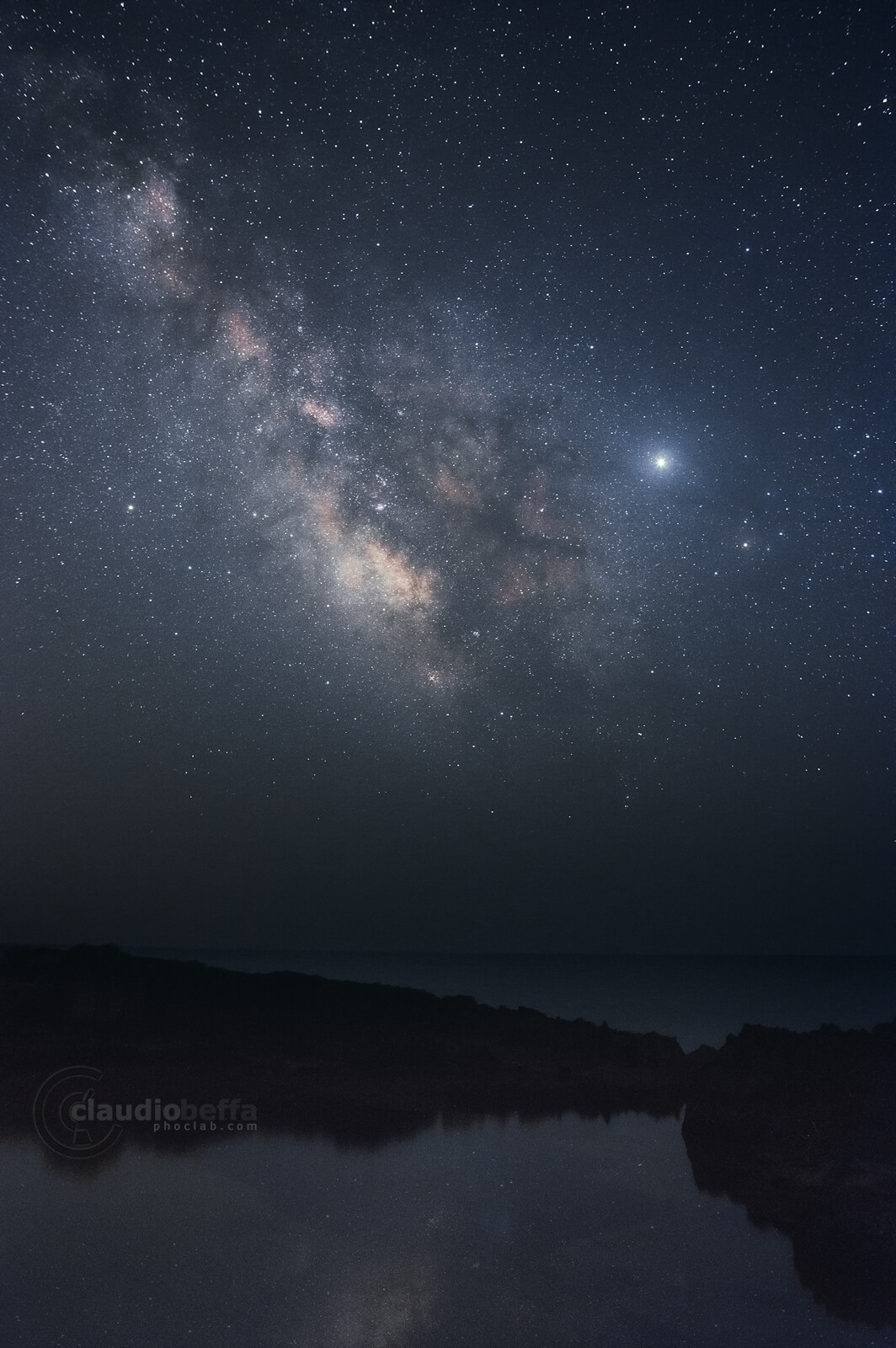
Dark mirror

Dark mirror: Milky Way mirrored on a pond in South Sardinia, Italy

Dark mirror, Southern Sardinia, Italy. In a perfect night of new moon, the Milky Way shows the bright core in all its magnificence. A faint reflection of it is perceivable on the still surface of a little pond, separated from the sea by a thin edge of rock.
Technically speaking, this is a fairly basic shot to execute. However, since the APS-C sensor of my camera and the lens I use are not exactly the best in class to shoot the Milky Way, I resorted to a “trick” which allows to improve the final image quality. Specifically, in order to capture as mush light as possible without incurring in an excessive noise penalty and avoiding at the same time the star trailing, I’ve blended 10 exposures for the sky, plus 4 for the foreground, with the addition of the dark frame.

EXIF:
Camera: Pentax K-3
Lens: Samyang 16mm f/2 ED AS UMC CS
Focal lenght: 16mm
Shutter time: 13 s
Aperture: F/2.5
Sensitivity: ISO3200


Carved pond

Carved pond: seascape with the blue hour colors, Sardinia, Italy

Carved pond. The sun has finally set, after a long and hot day of summer. The last light diffuses in the warm and humid air, painting a soft gradient of colors that mirrors on the still and shiny surface of a pond, inside the ancient punic quarry of Pixinnì, guarded by a watchtower.
The elements which I’ve wanted to put in relation one another in this photograph are the clean sky, whose delicate colors are mirrored on the polished surface of the water, and the harsh rocks of the quarry, whose rough surfaces have been carved first by the hands of men and then by the action of the wind and the water. As a result, there’s almost a sense of harmony between the opposites.
To capture this view I’ve used an ultra wide angle lens and two filters: a 6 stops ND which extended the exposure time to two minutes, smoothing out in this way the surface of the sea, and a 2 stops graduated ND filter, which darkened the sky just enough for better balancing the brightness of the scene. Then, with a fairly straightforward post processing, I’ve adjusted the local contrasts and the color balance of the scene, with the use of the luminosity masking.

EXIF:
Camera: Pentax K-3
Lens: Sigma 10-20mm f/3.5 EX DC HSM
Focal lenght: 10mm
Shutter time: 120 s
Aperture: F/8
Sensitivity: ISO100


Toward the totality

Toward the totality: total lunar eclipse in southern Sardinia, Italy.

Toward the totality. 2018, July 27th: the century’s longest total lunar eclipse occurs and, at the same time, the planet Mars reaches its opposition while it’s at its closest to Earth since 2003. As a result, this rare coincidence gifts us with a surreal and amazing night show.
Impossible for me to miss such a great wonder of nature. So, after some days of planning through the useful PlanIt app, I chose the beautiful Capo Carbonara, in southern Sardinia, to witness and capture the event. Not having with me a long tele lens, I decided to compose a particular scene, in order to show in a single frame the progression of the eclipse toward the totality, right above the lighthouse of Cavoli island.
Starting from about 21:00 to 23:00, I kept the camera steady in position capturing every phase of the totality every four minutes. Since the Moon has been inside the totality for almost the whole time, the arc drawn by it is colored with a vibrant tone of orange, differently from the “usual” eclipses in which this color is visible just for a few moments. Moreover, thanks to a clear night, the planet Mars has shone bright of a pale amber color.
During the totality, the Milky Way has been clearly visible at naked eyes. Nonetheless, my planning and my gears made me opt for a startrail, in order to emphasize the (real and apparent) movement of the heavenly bodies.

EXIF:
Camera: Pentax K-3
Lens: Pentax SMC DA* 50-135mm f/2.8 ED (IF) SDM
Focal lenght: 50mm
Shutter time: 0,8 s / 1 s / 1,3 s + 302 s
Aperture: f/3.5 + f/4
Sensitivity: ISO800 / 1000 / 1250 + 200


Stillness

Stillness, twilight time in southern Sardinia, Italy.

In the stillness of an hot midsummer day’s end, the twilight graces the sky with a pale and delicate gradient of colors. A lighthouse silently guards the calm sea. This soothing atmosphere, which seems to be timeless, lasts in reality just some minutes; however, the feelings conveyed by it last much longer in the eyes and the spirit.
To capture this fleeting moment, I’ve used a medium telephoto lens with two filters: a 3 stops ND which extended the exposure time enought to smooth out the water, plus a 2 stop graduated ND filter which darkened the upper portion of the sky, balancing so the brightness of the scene.

EXIF:
Camera: Pentax K-3
Lens: Pentax SMC DA* 50-135mm f/2.8 ED (IF) SDM
Focal lenght: 50mm
Shutter time: 30 s
Aperture: F/8
Sensitivity: ISO100


Full moon rising

Full moon rising over the island of Serpentara, southern Sardinia, Italy.

Full moon rising over the island of Serpentara: a few minutes after sunset, the soft colors of twilight began to darken and that brief period of time coincided with the rise of an amazing full moon. The humidity of the air and the very low angle above the horizon gave the Moon a vibrant yellow color with shades of orange and a slightly flattened shape. Watching the Earth’s satellite rising over the island’s profile has been an almost surreal sight and an exciting experience.
In order to take this shot I’ve used my longest lens, a 135mm (which is equivalent to about 200mm on full frame) and, to avoid even the slightest vibration, I used the “mirror lock-up” function on my camera. Nature did the rest

EXIF:
Camera: Pentax K-3
Lens: Pentax SMC DA* 50-135mm f/2.8 ED (IF) SDM
Focal lenght: 135mm
Shutter time: 1,3 s
Aperture: F/5.6
Sensitivity: ISO100


Softness

Softness: twilight over the island of Serpentara, southern Sardinia, Italy.

Before the arrival of the night, twilight gives brief moments of absolute quietness, embraced by a light which colors everything with softness and delicate hues.
The opportunity to witness ephemeral wonders like this is one of the most precious gifts we could receive; this makes me appreciate with great joy the moments I have, to stay in close contact with a nature that’s as beautiful as fragile.
To capture this fleeting moment, I’ve used a medium tele lens and a 4 stops ND filter, that extended the exposure time just enough to smooth out the surface of the sea.

EXIF:
Camera: Pentax K-3
Lens: Sigma 35mm f/1.4 DG HSM Art
Focal lenght: 35mm
Shutter time: 15 s
Aperture: F/7.1
Sensitivity: ISO100


The sleeping Boat Eater

The sleeping Boat Eater: a minimalist seascape of an iconic lighthouse in Sardinia, Italy.

“Faro Mangiabarche”, literally Boat Eater Lighthouse is probably the most iconic lighthouse in Sardinia: its two-faced soul makes it a reference point to entrust the life to, but at the same time also an harbinger of ruin and death, because it rises above a wide formation of harsh and spiky rocks which barely emerge from the surface of the sea. Many boats have been “devoured” by this place during fierce storms. Therefore, in this photograph I depicted it as a sort of vision of a sleeping entity.

The story behind this photograph starts with my wish to capture a “classic” view of the lighthouse lashed by the waves during a stormy day. So, the first thing I did has been to check the period of the year with the highest chances to catch an “ideal” day. Secondly, after some wait, I’ve checked four different weather forecast services to be sure that the chosen day was the right one. Finally, excited and full of enthusiasm, I’ve headed to the much aspired subject. However, during my hour and a half itinerary, I had begun to notice that the sky was not promising; confident about the concordance between the forecasts, I didn’t lend weight to it.
When I finally arrived to the destination, I’ve been welcomed by an amazingly… flat weather: light wind, an homogeneous blanket of clouds and an almost dead calm. After an initial discouragement, while observing the lighthouse, I thought about its story and its peculiarity, and I’ve decided to interpret its figure not as a “life saver” which fights during a storm, but as a sleeping and resting entity ina time of quietness.

Moral of this story: in landscape photography there’s nothing taken for granted, even if you cross-check 4 times; so, it’s useless to obsess over a prefigured shot and stick with it, it’s better to be flexible and adaptable because in every situation there’s a chance to make a nice photograph.

EXIF:
Camera: Pentax K-3
Lens: Pentax SMC DA* 50-135mm f/2.8 ED (IF) SDM
Focal lenght: 95mm
Shutter time: 36 s
Aperture: F/8
Sensitivity: ISO100
 

This photograph has been awarded three times at the following international photography competitions:
– Honorable Mention in the 2018 edition of the ipa Int’l Photography Awards: “The Sleeping Boat Eater” – Category Architecture/Other
– Honorable Mention in the 2018 edition of the ND Awards: “The sleeping Boat Eater” – Category Special/Long Exposure
– Nomination in the 2019 edition of the FAPA Fine Art Photography Awards: “Boat Eater” – Category Seascapes


Boat Eater realm

Boat Eater Realm: a seascape of an iconic place of Sardinia, Italy.

Boat Eater realm. In the small island of Sant’Antioco, south western Sardinia, there’s a well known place for the presence of a lighthouse. This part of the island is often subject to strong winds and fierce waves, so much that many boats sank right near the lighthouse. In this glimpse on the coastline, in front of which the Boat Eater lighthouse stands, I wanted to show in a “dramatic” way the harshness of nature, whose riskiness is often underestimated.
Even if this shot seems like a normal portrait view, in reality is a vertorama, in other words a portrait oriented panorama: it’s the sum of four landscape oriented shots, starting from the foreground and ending in the sky. This technique allowed me to capture a wider view of the scene, that a normal wide angle lens wouldn’t have managed to take; as a result, the foreground starts just some centimeters beyond the legs of the tripod. Moreover, to extend the exposure time, I’ve used a 10 stops ND filter, as usual.

EXIF:
Camera: Pentax K-3
Lens: Sigma 10-20mm f/3.5 EX DC HSM
Focal lenght: 16mm
Shutter time: 25 s
Aperture: F/5.6
Sensitivity: ISO100


Immutability

Immutability: A seascape of Sardinia.

Immutability. North western Sardinia, Italy. The incessant flow of the waves between the windswept cliffs and islets tells a story of immutability and balance between water, earth and air.
To make this photo, I’ve used a tele lens, whose focal lenght helped to compress the planes of depth, and two filters: a 10 stops ND filter to extend the exposure time, turning the waves into a impalpable mist, and a 2 stops graduated ND filter to darken the sky a bit, balancing the brightness of the scene. The strong wind did the rest…

EXIF:
Camera: Pentax K-3
Lens: PENTAX SMC DA* 50-135mm f/2.8 ED (IF) SDM
Focal lenght: 135mm
Shutter time: 20 s
Aperture: F/8
Sensitivity: ISO100


Amphitheatre waterfalls

Amphitheatre waterfalls: hidden gems of great beauty in sardinian back country.

Amphitheatre waterfalls. Sardinia is a region mostly renowned for its beaches and summer vacations destinations, being a mediterranean island; however, hidden in the back country there are so many amazing places that make Sardinia a real “treasure island”. One of the natural gems that I have had the pleasure to explore are the Lequarci waterfalls: as for many other waterfalls of the island, it’s possible to enjoy their beauty only after a rainy period, because they are fed by a torrential river. Therefore, during summer or a dry month, there are no waterfalls at all… Luckily, even if winter 2019/2020 has been quite dry, after a steep but not overly demanding trekking, I’ve reached the top of the plateau and I’ve found a sufficient flow to show the beauty and magnificence of Lequarci. The waterfall, branched in two main courses, takes a jump of 50 meters from a massive ridge of rock, to fall on a stony bed in the middle of a wood. The ridge’s shape, which resembles an amphitheatre, make the view on the valley even more scenic.
To capture this view I’ve used a 9 stops ND filters, which extended the exposure time, emphasizing in this way the water’s flow, and a 2 stops graduated ND filter to darken the sky a bit, avoiding to overexpose the brightest parts. Considering that the weather conditions and the light were about optimal, the photo editing that followed has been quite straightforward, requiring just some color and contrast adjustments made with the luminosity masking technique.

EXIF:
Camera: Pentax K-3
Lens: Sigma 10-20mm f/3.5 EX DC HSM
Focal lenght: 10mm
Shutter time: 119 s
Aperture: F/7.1
Sensitivity: ISO100


phoclab by Claudio Beffa © 2012-2021 All rights reserved - Privacy & Cookie Policy